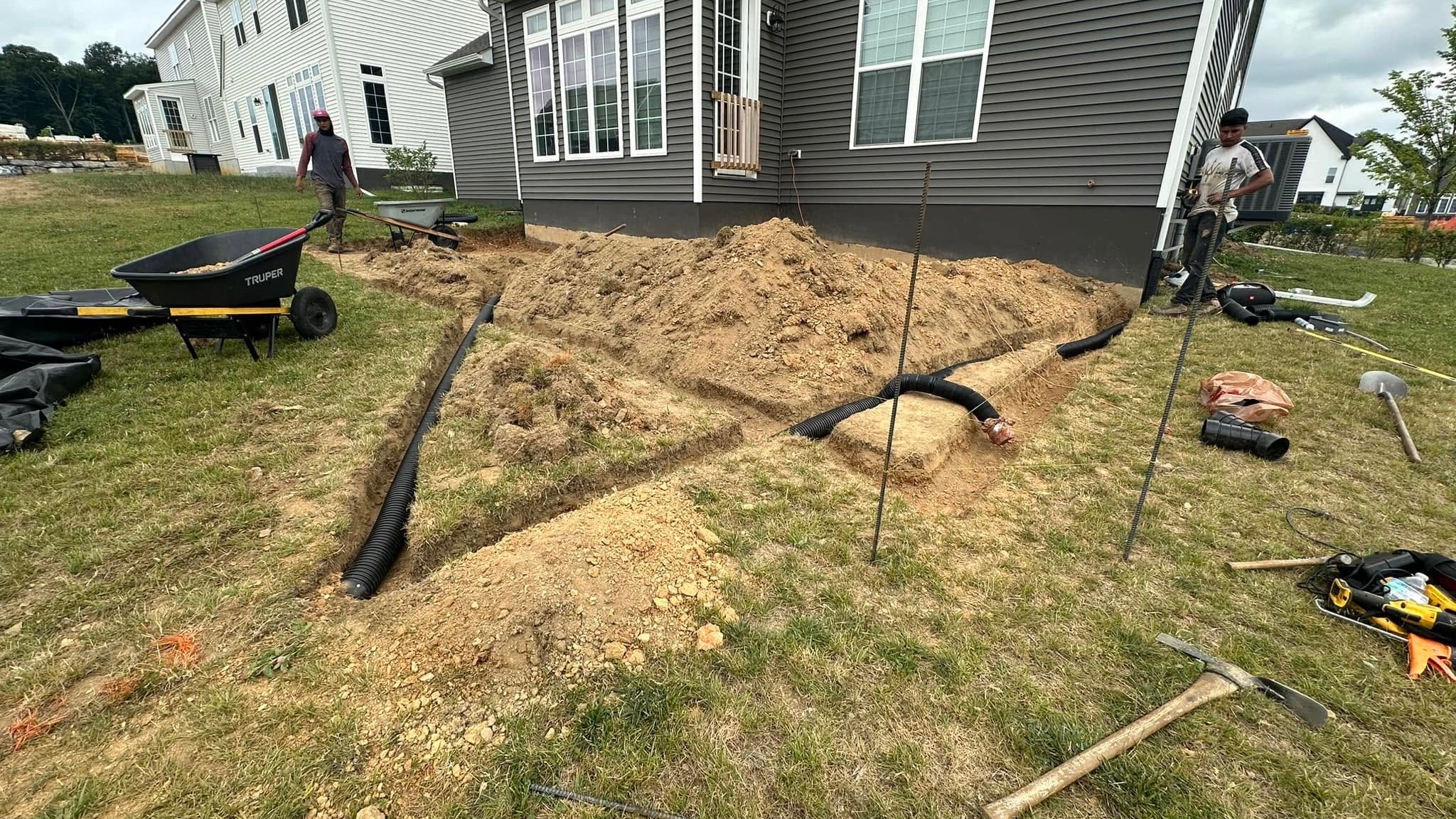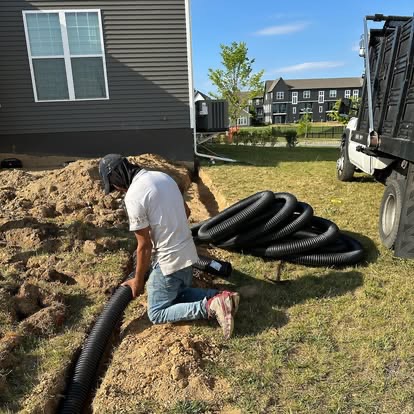
Most patios, walkways and other outdoor improvements change where rain runs off. If the drainage isn't planned and installed first, that water ends up against the house or under the new hardscape. On a lot of our patio jobs the drain pipe goes in before the base does.
Send a photo taken during or just after rain — that is when the problem is visible. We will tell you whether it is a grading problem or a drainage problem, because they have different fixes and different prices.
Most homeowners describe the symptom and assume the fix. They are not the same job, and the wrong one solves nothing.
Reshaping the ground so water runs where you want it. Fixes broad shallow pooling and negative slope toward a house.
A stone trench with perforated pipe that collects water below grade and carries it somewhere. Fixes a persistent wet area that grading alone cannot reach.
[VERIFY WHETHER DOWNSPOUT WORK IS INCLUDED.] Often the cheapest fix on the list and the first thing to check.
Every drainage system has to discharge somewhere legal and lower. [VERIFY HOW OUTLETS ARE HANDLED when there is no daylight to run to.]
[VERIFY THE FALL ALEJANDRO'S GRADES TO over the first several feet from a foundation.]
[VERIFY WHETHER SEED OR SOD RESTORATION IS INCLUDED after excavation.]
Usually one of three things — the ground falls the wrong way, there is a low spot with nowhere to drain, or roof water is being dumped next to the house and never carried away. Compacted clay makes all three worse, because water that cannot soak in has to run somewhere and sits wherever it stops.
Grading fixes water that is running the wrong way or spreading across a broad shallow area. A drain fixes water that has nowhere to go once it arrives. If the yard dries out a day after rain, it is usually grading. If it stays soft for a week, something needs to collect and carry it.
Yes, and it is the first thing to look at when a basement is damp. Ground that has settled toward the foundation delivers roof and surface water straight against the wall. Re-establishing fall over the first several feet out from the house is usually cheaper than any interior fix. [VERIFY THE FALL SPEC USED.]
They solve different problems and are often done together. Grading is the cheaper fix and always the first question. A French drain is what you add when there is a genuinely low area, a spring, or water arriving from a neighbouring property that reshaping the surface cannot redirect.
[VERIFY DRAINAGE AND GRADING PRICE RANGES — grading and French drain should be priced separately, since homeowners are usually choosing between them.] Length of run, depth, whether there is a usable outlet and machine access drive the number.
[VERIFY WHETHER LAWN RESTORATION IS INCLUDED OR QUOTED SEPARATELY, and whether it is seed or sod.] Worth asking any contractor before work starts — drainage work is trenching, and a yard that is fixed but torn up is only half done.
That is when the problem shows. Where the water sits and how long it stays tells us which fix it is.